Navigating the legacy data gap
In the aerospace and defense sectors, many mission-critical platforms are expected to remain in service for decades. This creates a significant challenge: what happens when a component needs to be replaced, but the original manufacturer is out of business or the design data has been lost to time? This is the “legacy problem,” and solving it requires a blend of digital archaeology and precision engineering. Custom metal forming dies are the key to bringing these parts back into production.
Statt Engineering thrives on these high-difficulty projects. We use a combination of 3D scanning, reverse engineering, and 5-axis mastery to recreate the complex surfaces of original parts. Once the digital model is perfected, we machine custom metal forming dies that allow for the accurate reproduction of the component. This process ensures that aging fleets can be maintained without the need for costly and time-consuming manual fabrication.
The precision of 5-axis die making
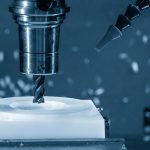
Creating a metal forming die for a legacy aerospace part is not a simple task of copying a shape. The die must account for the specific material properties of the alloy being formed, including its yield strength and springback characteristics. At Statt Engineering, we use precision 5 axis CNC machining to create die surfaces with elite accuracy. Our 190-inch envelope capacity means we can produce dies for large structural panels just as easily as for small, intricate brackets.
The advantage of using 5-axis technology in die making is the ability to achieve superior surface finishes. A smoother die surface reduces friction and prevents marring of the aerospace grade CNC parts during the forming process. This is particularly important for aerodynamic skins where surface integrity is a flight-safety requirement. Our engineering-first service model ensures that every die we produce is optimized for the specific press equipment and material requirements of the project.
A high-performance extension of your engineering team
When a lead engineer is faced with a legacy part crisis, they don’t need a vendor who just takes orders. They need a partner who can provide technical grit and creative problem-solving. Statt Engineering functions as a dependable, transparent extension of your team. We communicate clearly throughout the reverse engineering process, ensuring that the final custom metal forming dies meet all modern performance and safety standards.
We understand the pressure of keeping a production line or a fleet operational. The Big Shop bottleneck often makes legacy work a low priority for large vendors. At Statt, we prioritize these complex, high-stakes projects. Our nimble structure allows us to move from digital reconstruction to finished tooling with industry-leading lead times. We solve the capacity burden by providing the specialized expertise that larger, slower manufacturers often overlook.
Ensuring future resilience through digital archaeology
By creating new custom metal forming dies and the associated digital data, we don’t just solve a current part shortage: we ensure the future resilience of the platform. We provide our clients with the updated CAD files and documentation required for modern AS9100 and ITAR compliance. This turns a legacy liability into a managed asset.
As the industry continues to evolve toward 2026, the ability to bridge the gap between old-world craftsmanship and new-world precision will be a critical differentiator. Statt Engineering is committed to being the first-choice partner for complex die making and legacy part reproduction. We bring elite aerospace quality to every project, ensuring that zero guesswork is involved in maintaining the world’s most important aerospace and defense platforms.